By
Most people check a stock price the way they check the weather. They glance at it, feel good or bad, and move on. The trouble is that a price on its own tells you almost nothing about the business behind it.
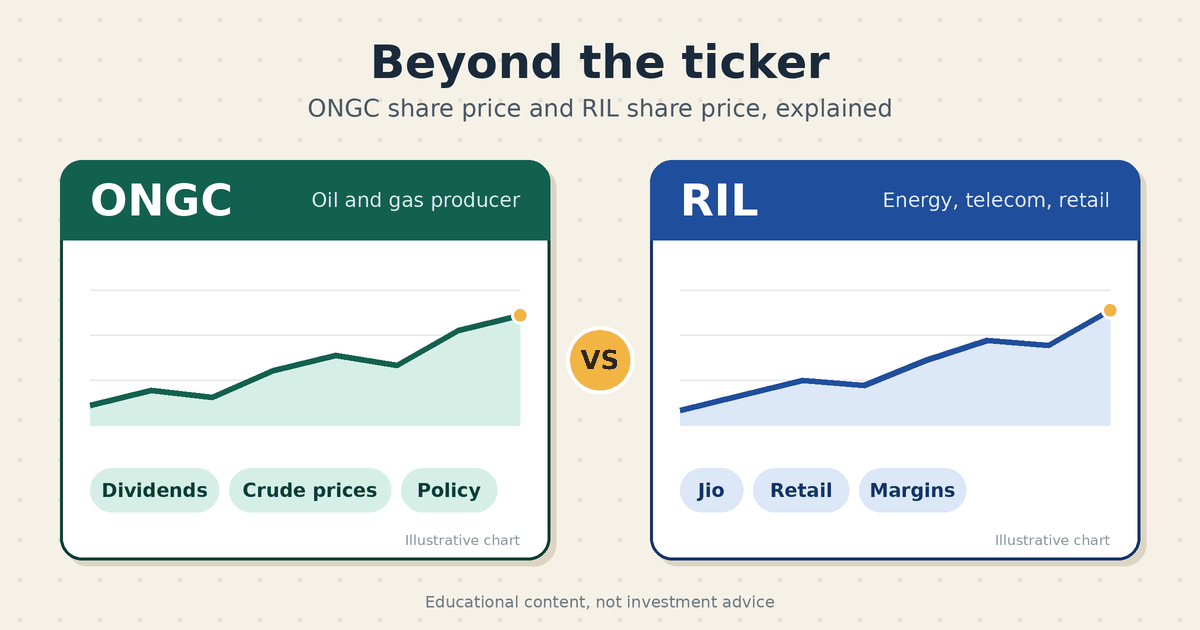
That is especially true for India’s two best-known energy names. When you open the ONGC share price page and then the RIL share price page, you are looking at two companies that happen to share a sector but not much else. This guide explains what each one actually does, why their stocks move, and how to think about them before putting money in.
Start with the business, not the chart
Imagine two shopkeepers on the same street. One sells only grain, bought and sold in bulk. The other runs a grocery, a mobile recharge counter, and a small clothing store. You would not judge their earnings the same way, even though both are “in retail”.
ONGC and Reliance are a bit like that.
ONGC is the grain seller. It is India’s largest crude oil and gas producer, and almost everything it earns comes from pulling hydrocarbons out of the ground and selling them. The government holds a controlling stake. Through its overseas arm, ONGC Videsh, it also has assets abroad, and it holds a majority stake in HPCL, which brings refining and fuel retail into the picture.
Reliance Industries is the multi-counter shop. Its refining and petrochemicals business is the original engine, but today it sits alongside Jio, which serves a huge number of mobile and broadband users, and Reliance Retail, one of the largest retail operations in the country. The group is also building out a new energy business.
So one stock is largely a view on energy prices. The other is a view on how India spends, communicates, and consumes.
Why the ONGC share price moves
Crude oil is the main dial. When global crude prices rise, ONGC generally earns more for every barrel it sells. When they fall, profits tend to shrink. No other factor comes close.
Government decisions matter more than you might expect. ONGC is state-controlled, so policy on subsidy burden-sharing, special taxes on oil producers, and domestic gas pricing can change its earnings quickly. A stock that looks cheap on paper can stay cheap for a reason, and policy risk is often part of that reason.
Output decides the long game. Older fields naturally decline, so the company must keep drilling and investing just to stay level. Fresh discoveries and the delivery of new offshore projects are what investors watch for.
Dividends shape sentiment. ONGC has a long record of paying dividends, which is why income-minded investors keep it on their radar. When the payout looks healthy, the stock often finds buyers.
Why the RIL share price moves
With Reliance, there is no single dial. Several move at once.
Refining and chemicals. The gap between what Reliance pays for crude and what it earns from fuel and chemicals is a key profit driver. It rises and falls with global conditions.
Jio and retail. Customer additions, revenue per user, new stores, and festive demand all affect how the market values these businesses. Many analysts treat them as separate growth stories on top of the energy base.
Big spending plans. Reliance is known for investing heavily in new areas. The market can cheer these plans or worry about them, depending on how clearly the returns are explained.
Announcements. The annual general meeting is one of the most watched corporate events in India. Statements about new ventures, partnerships, or listings regularly shift sentiment.
Side by side
| ONGC | RIL | |
|---|---|---|
| Who controls it | Government of India | Promoter-led private group |
| What it mainly does | Finds and sells oil and gas | Energy, telecom, retail, new energy |
| Biggest influence on profit | Crude and gas prices | A mix of margins and consumer growth |
| Why investors like it | Dividends, value appeal | Diversification, growth stories |
| Main worry | Commodity swings, policy risk | Heavy spending, execution risk |
Three mistakes people make when reading a share price
1. Treating a low price as a bargain. A stock priced at a few hundred rupees is not cheaper than one priced at a couple of thousand. Price per share depends on how many shares exist. What matters is the price relative to profit, assets, and growth.
2. Ignoring valuation ratios. Look at the price-to-earnings ratio to see what you are paying for each rupee of profit. The price-to-book ratio helps with asset-heavy firms like ONGC. Dividend yield tells you what the payout looks like against the current price. Compare each number with the company’s own history and with its sector, not with an unrelated stock.
3. Buying on a headline. A sharp one-day move after a news item feels urgent. It rarely is. Read the actual quarterly results before reacting, and check how the business has performed over several years rather than several days.
Matching the stock to the investor
If you are drawn to dividends and are comfortable riding out commodity cycles, ONGC may fit your thinking. Just accept that its path will track oil and policy, and neither is in your control.
If you prefer one holding that touches several parts of the economy, Reliance offers that spread. The flip side is that many things have to go right at the same time, and heavy investment phases can test patience.
Plenty of long-term investors own both because they respond to different triggers. When energy prices are strong, one may carry the portfolio. When consumer and digital growth lead, the other might. Still, owning both is not a rule. It depends on your goals, your time horizon, and how much volatility you can stomach without panic-selling.
A simple routine before you invest
- Read the latest quarterly results and management commentary.
- Check the valuation ratios and compare them with past levels.
- Note the debt position and the dividend history.
- Look at the 52-week range to see where the price sits today.
- Decide how much of your portfolio this one stock should be, and stick to it.
Always use up-to-date figures from a reliable platform. Old screenshots and forwarded messages go stale fast.
Final thoughts
The ONGC share price and the RIL share price are worth following because they teach you something bigger than either company: two businesses in the same sector can behave in completely different ways. Once you understand what each one actually earns from, the daily price swings start to make more sense, and your decisions become calmer.
Do your own research, think about your goals, and take your time.
Disclaimer: This article is for educational purposes only and is not investment advice. Investments in the securities market are subject to market risks. Please read all related documents carefully and consult a SEBI-registered advisor before investing.